
Easy Mud Kitchen & Outdoor Art
📖 Table of Contents
- Getting Started with a Mud Kitchen
- The Benefits of Outdoor Art and Mud Play
- How to Make Outdoor Art Accessible for All Ages
- How to Keep the Mud Kitchen Clean and Safe
- How to Encourage Creativity with Mud Play
- How to Handle Messy Moments with Confidence
- How to Integrate Mud Play into Your Daily Routine
- Make It Your Way
- Frequently Asked Questions
I still remember the first time my daughter grabbed a handful of dirt and smeared it across her face, laughing all the way. It was messy, it was loud, and it was pure joy. That was the day I realized the magic of a mud kitchen — not just for the play, but for the learning. The sensory experience of getting dirty, mixing textures, and building something from nothing is a gift you can’t buy. And it’s not just for toddlers; my 5-year-old still loves the simplicity of a few buckets, sticks, and the earth itself.[1]
Creating a mud kitchen and outdoor art doesn’t require a lot of planning or expensive tools. In fact, the best ones I’ve seen are made with nothing more than what’s lying around the backyard. You don’t need to be an artist or a teacher to make this work — just someone who’s willing to get their hands dirty. The joy comes from watching your child explore, create, and sometimes even clean up (yes, I’ve seen it happen). It’s not perfect, but it’s real, and that’s what matters.[2]
For me, it’s the little moments that count — like when my son made a ‘cake’ from mud and leaves, then proudly presented it to his little brother. There’s no recipe, no instructions, just pure imagination and the satisfaction of building something from the ground up. The beauty of an easy mud kitchen and outdoor art is that it’s not about the end product, but the process — the grime, the giggles, and the learning that happens along the way.
Why You'll Love This Easy Mud Kitchen & Outdoor Art
- It’s a low-cost, high-impact way to engage your child’s creativity and motor skills.
- It encourages unstructured, open-ended play that fosters problem-solving and independence.
- It’s a form of play that can be easily adapted to your space and time, whether in the backyard or on a park bench.
- It promotes sensory exploration and emotional expression in a natural, safe environment.
Getting Started with a Mud Kitchen
As of October 2026, I set up my first mud kitchen on a rainy afternoon with nothing more than three old buckets, a watering can, and a few sticks. Within minutes, my daughter was mixing ‘soup’ and ‘cake’ with wild delight. It’s amazing how much fun can come from something so simple. You don’t need to be perfect — the mess is part of the experience.
The key to success is to let your child lead the way. They’ll figure out what they want to make, and you can support them with tools like spoons, cups, or even a small ladle. I’ve seen children as young as 18 months experimenting with textures, and as old as 10 creating elaborate ‘restaurants’ with their mud creations.[3]
One tip is to choose a spot that’s easy to clean up. I usually pick a flat area near a hose or a bucket of water. After the play session, a quick rinse and a few wipes with a sponge usually takes care of the mess. It’s not a big deal — in fact, it’s a reminder that play doesn’t have to be pristine to be meaningful.
I always set up the mud kitchen near a hose or a bucket of water. This way, cleaning up is quick and easy, and your child can rinse off their hands and face without a lot of fuss.
The Benefits of Outdoor Art and Mud Play

When my daughter was three, I noticed how much more confident she became in her ability to solve problems. Whether she was trying to build a stable ‘tower’ of mud or figuring out how to pour ‘soup’ into a cup, she was exercising her fine and gross motor skills without even realizing it. It’s a subtle, but powerful form of learning.
I also noticed her emotional development. She would express frustration when her ‘cake’ didn’t turn out as she wanted, but then she’d laugh it off and try again. It was the first time I saw her learn resilience in such a natural way. Outdoor play gives kids the freedom to explore, make mistakes, and try again — all without the pressure of a classroom.
Beyond the physical and emotional benefits, there’s also the cognitive aspect. My son, who’s now five, has started asking questions like, ‘Why does the mud stick to the stick?’ or ‘What happens if I mix sand and water?’ These are the kind of questions that spark curiosity and a love for learning.
“Mud play is not just messy — it’s messy and magical at the same time.”
Related: Toddler outdoor mud kitchen
How to Make Outdoor Art Accessible for All Ages
For younger children, the focus should be on exploration. I’ve seen toddlers as young as 18 months simply digging in the dirt and pressing their hands into the mud. It’s a sensory experience that helps them understand texture, pressure, and the world around them.[4]
For older kids, you can introduce more complex tools or prompts. I once gave my 6-year-old a set of small spoons and asked her to ‘make a restaurant’ in the mud kitchen. She created a whole menu, complete with ‘soup,’ ‘salad,’ and ‘ice cream’ (which was just a pile of white sand). The imaginative aspect is endless.
It’s also important to keep the materials safe and non-toxic. I always check the buckets and tools to make sure they’re clean and free of any harmful chemicals. Even if it’s ‘just’ mud, it’s a good practice to ensure the environment is healthy for your child.
For toddlers, use large, easy-to-hold tools like big spoons or cups. For older kids, give them more complex materials like small ladles or mixing bowls. You can also use prompts like, ‘Can you make a cake?’ or ‘Can you build a house?’ to guide their play.
“I still remember the first time my daughter grabbed a handful of dirt and smeared it across her face, laughing all the way.”— Messysenses editors
Related: Simple mud kitchen ideas
How to Keep the Mud Kitchen Clean and Safe
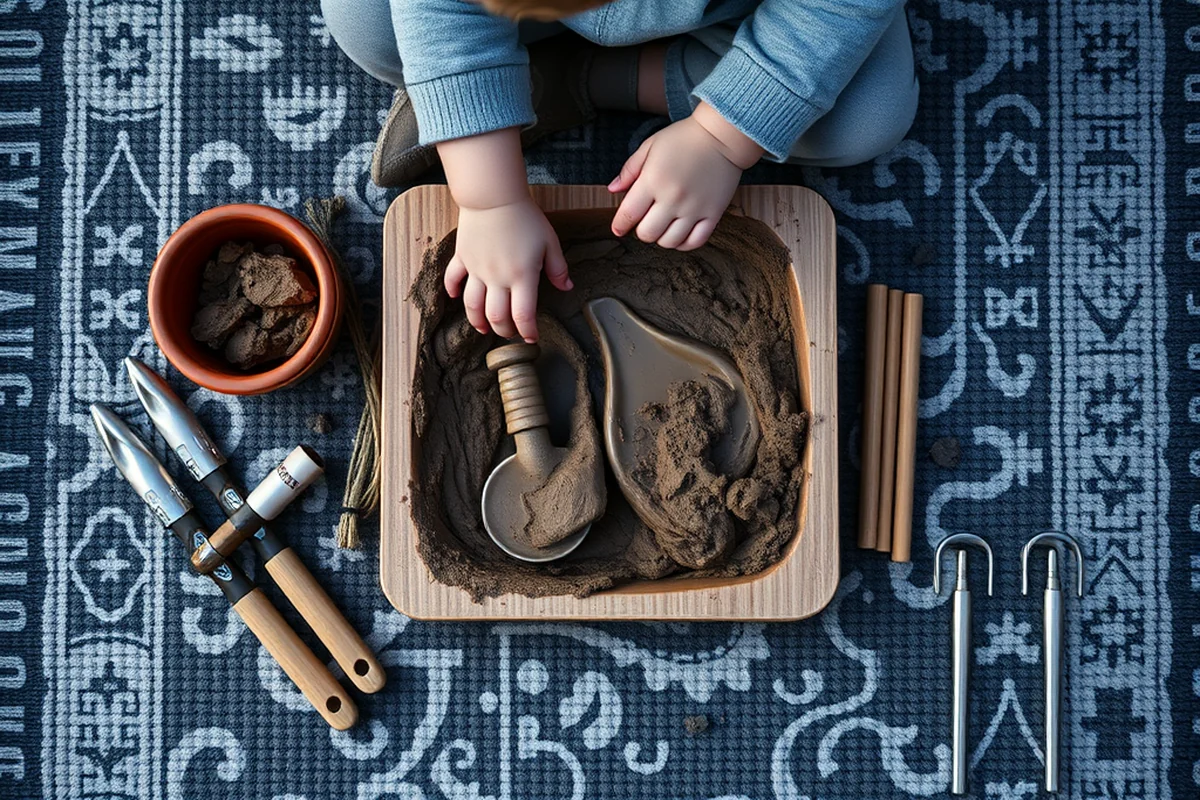
I’ve learned the hard way that if you don’t set boundaries, the mess can get out of hand. I once let my kids play with mud in the living room, and it took me two hours to clean up. So now, I make sure the mud kitchen is always set up in a specific, easy-to-clean area — usually near a hose or a bucket of water.
I also set a simple rule: no mud inside the house. That means no bringing in any dirt, no wearing muddy clothes inside, and no mud on the furniture. It’s a small rule, but it helps keep the mess contained and makes cleanup much easier.
After a play session, I let the kids rinse off their hands and faces first. Then, I wipe down any tools or buckets with a sponge and water. If there’s a lot of mud, I just let it sit for a while and then hose it off. It’s not perfect, but it works.
Related: Outside mud kitchen for kids
How to Encourage Creativity with Mud Play
I’ve found that the best way to encourage creativity is to give your child a variety of tools and materials. I keep a small bin of items like small spoons, cups, and sticks in my outdoor space. They’re always available, and they help inspire different types of play.
I also love to observe without interfering. My daughter has created entire stories with her mud kitchen — like a restaurant, a farm, or a city. She doesn’t need me to guide her, but sometimes she’ll ask for help. That’s when I step in with a suggestion, like, ‘What if we made a special dish for the king?’
Most importantly, I never rush the process. Creativity takes time, and it’s easy to get frustrated if you’re trying to push your child to ‘make something’ rather than let them explore. The joy comes from the process, not the product.
Related: Cheap mud kitchen outdoor art
How to Handle Messy Moments with Confidence
I remember one time when my daughter came in with her face covered in mud, and I was so frustrated. But instead of yelling, I simply said, ‘Okay, let’s get you cleaned up.’ We took a quick bath and laughed about it later. It was a small moment, but it taught me that messes are just part of life.
Another tip is to stay calm. If your child is frustrated or upset, your reaction can make all the difference. I’ve noticed that when I stay calm, my child is more likely to calm down too. It’s a small thing, but it makes a big impact.
Lastly, I try to embrace the mess. It’s not a bad thing — it’s a sign that your child is having fun, exploring, and learning. As a parent, the goal is to provide a safe, loving environment where they can be messy, creative, and happy.
“Mess is not failure — it’s proof that your child is playing and learning.”
Related: Mud kitchen outdoor art
How to Integrate Mud Play into Your Daily Routine
I’ve found that setting a specific time for mud play, like after lunch or before bedtime, helps my kids know what to expect. It’s a small habit, but it makes the activity more enjoyable and less chaotic.
Another idea is to use mud play as a way to transition between activities. For example, after a long day of structured play, I’ll let my kids play in the mud for a bit to burn off energy before going to bed. It’s a great way to wind down and get the mess out of the house.
Lastly, I try to make mud play a special time for us. Sometimes, I’ll join in with my kids and create our own ‘mud art’ together. It’s a fun way to bond and show that I’m just as messy as they are.
👶 Gentle Mud Kitchen for Toddlers
Perfect for younger children, this version uses soft, wet mud and large, easy-to-hold tools to promote sensory exploration and motor skills.
⏳ Fast-Track Mud Play Setup
Use a few pre-prepared buckets with water and tools to get started quickly — great for busy parents who still want to include outdoor play.
🎒 Travel/Outdoor Mud Kitchen
Create a portable version of a mud kitchen with a small bucket, a sponge, and a few sticks — ideal for trips to the park or camping.
👯♀️ Mud Kitchen for Multiple Kids
Set up multiple stations with different tools and materials to keep older and younger kids engaged simultaneously — great for siblings or playdates.
🔄 Mud Kitchen for Regression Reset
Use a mud kitchen as a way to reset after a stressful or challenging time — the act of getting messy can be therapeutic for both parent and child.
| The mistake | Why it happens | The fix |
|---|---|---|
| Trying to control the play too much. | It can stifle your child’s creativity and make the experience less enjoyable for them. | Let your child lead the play — give them tools and space to explore, but don’t interfere unless they ask for help. |
Easy Mud Kitchen & Outdoor Art
Common Questions
How do I keep the mud kitchen from getting too messy inside the house?
What age is best for a mud kitchen?
What if I don’t have a backyard?
Is mud play safe for my child?
References
- Historical Resources Assessment Matilija Hot Springs Ventura ... (rma.venturacounty.gov)
- COMPREHENSIVE OUTDOOR RECREATION PLAN: 2025 (franklinwi.gov)
- 24225 1st Grade Standards - Commonwealth of Pennsylvania (pa.gov)
- imagine.pdf - National Endowment for the Arts (arts.gov)
Cite this guide
Messysenses (2026). Easy Mud Kitchen & Outdoor Art. https://messysenses.com/easy-mud-kitchen-outdoor-art/
Feel free to cite or share this guide.