
Children Playing With Playdough
📖 Table of Contents
I remember the first time my son grabbed a handful of playdough and squeezed it with his tiny fingers, the way the color bled and stretched like magic. It was the kind of moment that makes you pause, watching a child’s eyes light up as they mold a shape that looks like a dinosaur or a castle. I didn’t know then that this small, squishy toy would become one of the most powerful tools in our home for learning, creativity, and emotional growth. Children playing with playdough isn’t just fun—it’s a gateway to a whole world of development.[1]
There’s something so satisfying about the way playdough feels under a child’s hands, like warm clay that never dries or cracks. It’s not just a toy; it’s a sensory experience that can be tailored for different ages and stages. My daughter started with simple colors and shapes, and now, at almost four, she’s making intricate scenes with tiny details, complete with roads, trees, and even a pretend bakery. I’ve watched her learn about colors, textures, and even basic math through play, all while she’s having what feels like the best time in the world.
But playdough is more than just a creative outlet. It’s a tool that helps children explore their emotions, practice fine motor skills, and even build resilience. When my son was three and going through a tough time, he’d sit for hours with a ball of playdough, pressing it into shapes and then pulling it apart, over and over again. It was like therapy for him, and I could see the tension in his little face slowly melt away with each squish and stretch. Children playing with playdough is a form of storytelling, problem-solving, and emotional expression I never expected to see in such a simple, squishy ball of fun.[2]
Why You'll Love This Playdough Experience
- Boosts fine motor skills and hand-eye coordination in children as young as 18 months.
- Encourages imaginative and creative play, allowing kids to explore different scenarios and roles.
- Provides a sensory-rich experience that can be calming and engaging for children of all temperaments.
- Supports emotional development by giving kids a safe way to process feelings through play.
The Power of Playdough in Early Childhood
As of August 2026, I’ve seen the difference playdough makes in my son’s early development. At 18 months, he was hesitant to use his hands for anything other than grabbing. But when I introduced playdough, he immediately started pressing and poking it, and within days, he was making small balls and flattening them with his palms. It was like unlocking a new part of his brain. The texture and resistance of the playdough helped him build strength in his fingers, which later translated into better control when he started drawing and using utensils.[3]
Beyond the physical development, playdough has helped my son understand cause and effect. He learned that pressing harder made the dough flatten more, and that rolling it between his fingers created different shapes. These are the kinds of discoveries that happen in the moment, and they’re all part of early cognitive development. The best part is that he never realized he was learning—playdough just became his favorite way to explore.[4]
I also love how playdough can be used for storytelling. One day, my son made a little house out of playdough. Then he said, 'This is where the baby lives.' I didn’t know that was a concept he was trying to process, but playdough gave him a way to express it. It’s amazing how a simple toy can become a language for children who haven’t learned to talk yet.
When introducing playdough to young children, begin with simple colors and avoid overcomplicating the experience. Let them explore the texture and shape without pressure to create anything specific.
The Emotional Outlet of Playdough

There was a time when my daughter was going through a tough phase at preschool, and she came home with a lot of sadness in her little face. I noticed her sitting at the kitchen table, playing with playdough for hours, pressing it hard and then letting it fall apart. It was clear she wasn’t talking about what was happening, but the playdough was her way of releasing the tension. I didn’t push her to explain—sometimes, she just needed the outlet.
Playdough can become a form of emotional release for children who don’t yet have the words to express what they’re feeling. One day, I saw my son smash a ball of playdough into the floor, and then he sat there, looking at the pieces. I didn’t say a word. He picked up the pieces and started rebuilding it, piece by piece. It was like he was learning how to repair things in life, even when they felt broken.
I’ve noticed that when my children are feeling overwhelmed or frustrated, playdough becomes their go-to calming tool. It’s not just about the squishing and stretching—it’s about the control and focus that comes with molding something from nothing. It’s a way for them to reclaim their emotions and find peace in the chaos.
Sometimes, the best way to heal is to squish it all out.
Related: Clay dough for kids
Related: Where to buy playdough
Related: Playdough creative play ideas
Related: Modeling Clay Vs Playdough
Related: Cheap toddler playdough clay
Related: Simple Playdough Recipe For Kids
Related: Playdough Making For Children
Related: Fish Coloring In Pages
Related: What Is Color Sheets
Related: Toddlers Playing With Playdough
Related: What Is A Kawaii Coloring Book
Related: Playdough Recipe For Children
Playdough for Fine Motor Skills
Fine motor skills are crucial for a child’s development, and playdough is one of the best tools for building them. I’ve seen my son go from struggling to pick up small objects to being able to grasp a pencil with ease, all thanks to the daily practice with playdough. The act of rolling, pinching, and flattening the dough strengthens the small muscles in his hands and fingers, which are essential for writing, buttoning clothes, and other everyday tasks.
I remember when my daughter was learning to use scissors, and she had a hard time keeping the paper from slipping. Her teacher suggested she practice with playdough first, and within a week, she was able to cut straight lines. It was a small step, but it made a huge difference in her confidence and ability to complete tasks independently.
What’s even better is that playdough can be used in different ways to target specific skills. For example, I’ve seen her use it to practice cutting with a knife, which has helped her get ready for more advanced art activities. Playdough doesn’t just teach creativity—it also builds the physical abilities that support learning in other areas.
Introduce playdough with different tools like rollers, cookie cutters, and even knives (under supervision) to help develop fine motor skills in unique ways.
“I remember the first time my son grabbed a handful of playdough and squeezed it with his tiny fingers, the way the color bled and…”— Messysenses editors
Playdough and Emotional Regulation
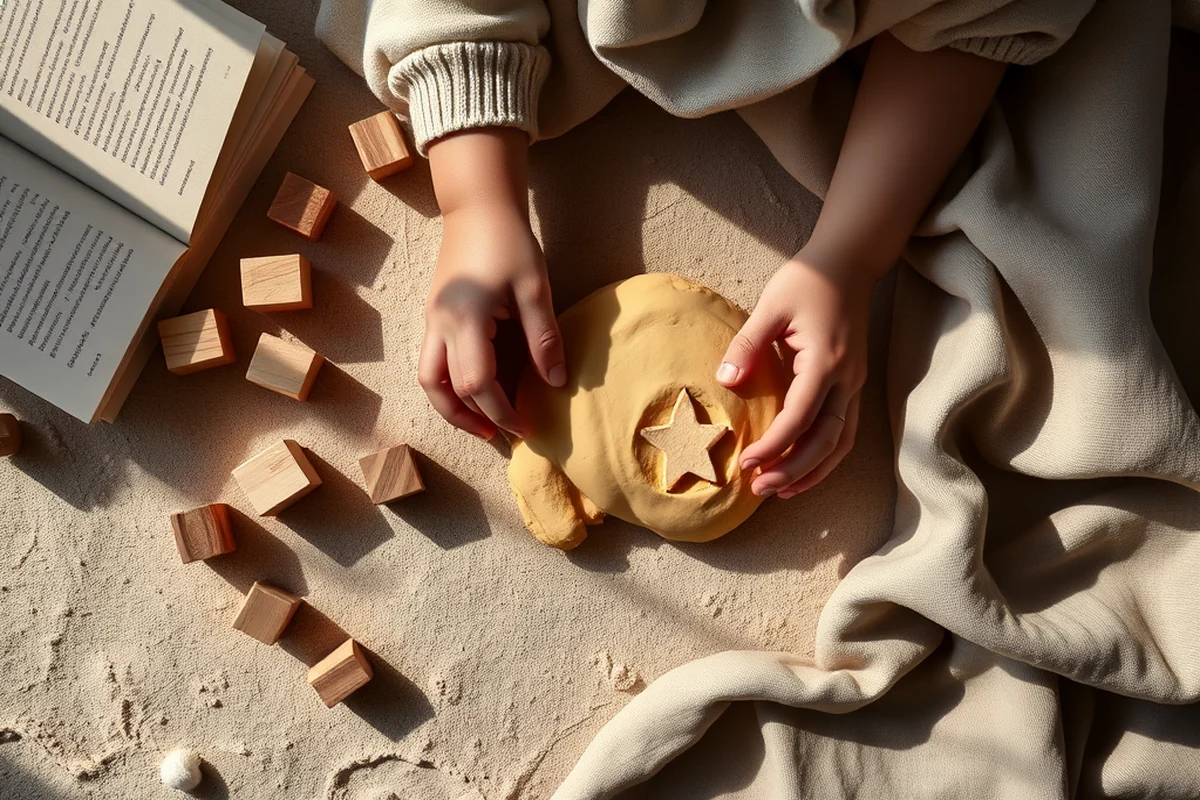
I’ve used playdough as a way to help my children calm down when they’re feeling overwhelmed. When my son was upset about a broken toy, I would sit with him and offer a ball of playdough. He’d start pressing it, kneading it, and eventually, the tension in his face would ease. It was like a reset button for his emotions.
Playdough is a non-verbal way for children to express their feelings. I remember one day, my daughter was very quiet after a difficult day at school. She just sat at the table with a piece of playdough, making it into small balls and then flattening them again. I didn’t ask her questions—she didn’t need to answer. She needed space to process, and the playdough gave her that.
In our home, playdough has become a go-to tool for emotional regulation. It’s not just for little kids—it works for all ages. I’ve seen my husband use it too when he’s feeling stressed. It’s a reminder that even adults can find solace in the simple act of molding something from nothing.
The Social Benefits of Playdough
I’ve noticed that when my children play with playdough together, they’re more likely to talk, share, and collaborate. One day, my daughter and her cousin were making a pretend village, and they had to agree on where to place the houses and what to name the streets. It was a small moment, but it showed me how playdough can be a catalyst for social development.
When my son was in a playgroup, I saw him teaching other kids how to make shapes with playdough. It was the first time I saw him take on a leadership role, and it was incredibly rewarding. He was explaining things clearly, and the other kids were listening. It was like he was learning how to communicate and teach at the same time.
Playdough has also helped my children learn the value of taking turns and respecting each other’s space. When we play together, I encourage them to wait their turn and ask for what they need. It’s a lesson that sticks because it’s embedded in the fun of the activity.
Playdough and Cognitive Development
I’ve seen the way playdough helps my children think through problems. One day, my daughter was trying to make a bridge out of playdough, and she kept it collapsing. She didn’t give up—she kept adjusting the shape, making it wider and stronger until it finally held. That was a moment of problem-solving, and I was proud to see her persistence.
Playdough also helps develop spatial awareness. My son has been fascinated with making shapes that fit together, and he’s learned how to balance and stack them in ways that make sense. It’s a hands-on way for him to understand how things fit in space, and it’s all part of building his cognitive skills.
What I love most is that playdough encourages experimentation. I’ve watched my daughter try different methods to create a tunnel for her toys, and each time, she learns something new. It’s a kind of learning that’s not forced—it’s natural, and it’s happening right in front of me.
Every failed bridge teaches a lesson in resilience.
Playdough and Creativity
One of the best things about playdough is that it allows children to create without limits. My daughter has made everything from animals to entire cities, and each time, she’s telling a different story. It’s amazing to see how her imagination runs wild with just a ball of playdough in her hands.
I’ve watched my son make a whole scene with playdough, complete with a car, a house, and even a little tree. He’s not just playing—he’s creating a whole world, and it’s all his. It’s a form of storytelling that’s unique to him, and it’s something I never would have expected from a simple toy.
The beauty of playdough is that it gives children a blank canvas to explore their creativity. It’s not about making the perfect shape or following instructions—it’s about letting their imagination take the lead. That’s what makes it so special.
🧸 Gentle Approach
Ideal for younger children or those with sensory sensitivities, this approach focuses on exploration and comfort without pressure.
🚀 Fast-Track Play
Perfect for parents who want to maximize learning and creativity in a short amount of time, with guided play sessions.
🧳 Travel/On-the-Go
Designed for families on the move, this variation uses lightweight, portable playdough kits that can be used anywhere.
👨👩👧👦 Multiples
Tailored for siblings and playgroups, this approach encourages teamwork, sharing, and collaborative creativity.
🔄 Regression Reset
A method used to help children with developmental challenges or emotional setbacks, using playdough as a tool for rebuilding skills.
| The mistake | Why it happens | The fix |
|---|---|---|
| Using too much playdough at once. | Using too much playdough can be overwhelming for children, especially younger ones, and may lead to frustration or a lack of engagement. | Start with a small amount of playdough and gradually increase as your child becomes more comfortable and interested in the activity. |
| Not allowing the child to explore freely. | Imposing too many rules or expectations can stifle creativity and make playdough feel like a chore rather than a fun activity. | Give your child the freedom to explore playdough without pressure. Let them lead the way and be present to observe and support their creative process. |
| Using playdough as a substitute for other learning activities. | While playdough is a valuable tool, it shouldn’t replace other important developmental activities such as reading, physical play, or structured learning time. | Balance playdough time with other activities that support your child’s growth in different areas, such as reading, art, and physical play. |
| Forcing the child to use playdough if they’re not interested. | Forcing a child to engage with playdough when they’re not interested can create negative associations and reduce their enthusiasm for future play sessions. | Respect your child’s interests and allow them to choose when and how they want to engage with playdough. Offer it as an option, not a requirement. |
Children Playing With Playdough
Common Questions
Can playdough be used for kids with sensory processing issues?
How can I encourage my child to use playdough more creatively?
Is playdough safe for young children?
How can I make playdough more engaging for my child?
References
- Child Care Behavior Handbook - King County (cdn.kingcounty.gov)
- The New York State Prekindergarten Learning Standards (ccf.ny.gov)
- Milestones by 3 Years | Learn the Signs. Act Early. - CDC (cdc.gov)
- The South Dakota Early Learning Guidelines (doe.sd.gov)
Cite this guide
Messysenses (2026). Children Playing With Playdough. https://messysenses.com/children-playing-with-playdough/
Feel free to cite or share this guide.