
Mud Kitchen & Outdoor Art
📖 Table of Contents
- What Exactly Is a Mud Kitchen?
- How to Set Up a Mud Kitchen in Your Yard
- Why Outdoor Art and Mud Play Are Important for Kids
- How to Encourage Creativity in a Mud Kitchen
- How to Keep a Mud Kitchen Clean and Organized
- How Often to Use a Mud Kitchen and Outdoor Art Activities
- How to Involve the Whole Family in a Mud Kitchen
- Make It Your Way
- Frequently Asked Questions
I remember the day my daughter turned three, and we spent the entire afternoon in the backyard, building a fortress out of mud, sticks, and leaves. She was covered in dirt, laughing until her cheeks hurt, and for the first time in weeks, I felt a deep, unshakable calm. We had created a mud kitchen — not just a play area, but a space where creativity, sensory exploration, and imagination collided. That day, I realized that mud is not a mess to be cleaned up, but a medium for learning and joy.[4]
Mud kitchens and outdoor art are more than just a trend — they’re a way to bring children into the present moment, to let them explore the world through their fingertips and their hearts. I’ve watched my children dig their hands into soil, mix water with leaves to create paint, and shape clay into stories. These are not just games; they’re lessons in texture, color, and resilience. And for parents, they’re a chance to step back and let our kids lead the way.
Since that first day, I’ve spent years experimenting, observing, and learning. I’ve tested different setups, from small backyard corners to sprawling outdoor spaces, and I’ve learned what works and what doesn’t. I’ve counted the time it takes to set up a mud kitchen, tracked the number of times a child can rework a sculpture, and even measured the satisfaction levels in my own family. This is not just a guide — it’s a story written in dirt, water, and joy.
Why You'll Love This Approach to Outdoor Play
- Encourages unstructured, imaginative play that builds creativity and problem-solving skills
- Promotes sensory development through hands-on exploration of textures, colors, and natural elements
- Strengthens family bonds through shared, messy, and deeply engaging activities
- Offers a low-cost, high-reward way to bring play and learning into the outdoor space
What Exactly Is a Mud Kitchen?
As of August 2026, a mud kitchen doesn’t need to be anything fancy — it can be as simple as a few buckets of water, a pile of soil, and a couple of sticks. My daughter’s first mud kitchen was just a corner of our backyard with a small tarp for collecting dirt and a watering can for mixing. It became a hub of creativity, and the first time she made a 'soup' with leaves and mud, she looked at me with eyes wide with pride.[1]
Children are naturally drawn to the sensory experience of mud — its coolness, its texture, the way it slips between their fingers. I’ve watched my son dig into a patch of soil, run his hands through it. Then proudly declare it 'the best dirt in the world.' It’s a simple, unfiltered form of play that builds confidence and curiosity.
Mud kitchens are not just about play — they’re about learning. My daughter once asked me, 'Why is this mud brown and this one gray?' I didn’t know the answer, so we looked it up together. That moment taught me more about science and curiosity than any textbook ever could.
You don’t need to buy anything expensive — just find a spot in your yard with dirt and water. Even a small tarp or a couple of buckets can turn any corner into a mud kitchen.
How to Set Up a Mud Kitchen in Your Yard

I set up our first mud kitchen in the corner of our backyard, where the sun was warm and the soil was soft. I brought out a few buckets, a watering can, and a small tarp for collecting dirt. My daughter was instantly drawn to it, and the first thing she did was dig a hole and fill it with water. It didn’t take long for her to create a 'mud kitchen' with sticks acting as spoons and leaves as ingredients.
I’ve learned that the best mud kitchens are those that are open-ended. You don’t need to guide the play — let your child lead the way. My son once built a 'restaurant' out of sticks and leaves, serving 'soup' made from mud and water. It was messy, but it was also deeply engaging and incredibly creative.
I found that the key to a successful mud kitchen is to keep it simple and flexible. You don’t need to spend a lot of money — just provide the basics and let your child’s imagination do the rest.
Let your child lead the way — the best mud kitchens are the ones that evolve from their ideas.
Related: How to draw a mud kitchen
Related: Best mud kitchen for kids
Related: Cheap Mud Kitchen & Outdoor Art
Related: Outside Mud Kitchen For Kids
Related: Simple mud kitchen ideas
Related: Outdoor Mud Kitchen For Kids
Related: Toy Story Coloring Pages
Related: Outdoor Wooden Mud Kitchen
Related: Making A Mud Kitchen
Related: Outdoor Mud Kitchen Plans
Related: A Cute Axolotl Coloring Page
Related: Mud Kitchen Near Me
Related: Outdoor Mud Kitchen For School
Related: Mud Kitchen & Outdoor Art For Toddlers
Related: Mud Kitchen & Outdoor Art Tips
Related: How To Build A Mud Kitchen Videos
Related: Easy Mud Kitchen & Outdoor Art
Related: Mud Kitchen & Outdoor Art Ideas
Why Outdoor Art and Mud Play Are Important for Kids
I’ve noticed that my daughter becomes more focused and less fussy when she’s playing with mud. It’s as if the tactile experience of the dirt calms her, and she spends hours exploring without needing constant redirection. I’ve even seen her sit for 20 minutes, just playing with water and leaves, completely absorbed in her own world.[2]
Outdoor art isn’t just about making things — it’s about learning how to think. When my son made a sculpture out of sticks and leaves, I asked him what it was. He said it was a 'spaceship' and told me it was going to 'save the Earth.' That kind of imaginative thinking is powerful and worth encouraging.
These activities also help kids develop emotional regulation. When my daughter was upset, I’d let her go to the mud kitchen and play for a while. The act of digging and creating seemed to help her process her emotions in a way that talking or even crying couldn’t.
Encourage creativity by allowing your child to use any materials they want — from leaves to sticks to even rocks. It’s all part of the learning process.
“I remember the day my daughter turned three, and we spent the entire afternoon in the backyard, building a fortress out of mud, sticks, and…”— Messysenses editors
How to Encourage Creativity in a Mud Kitchen
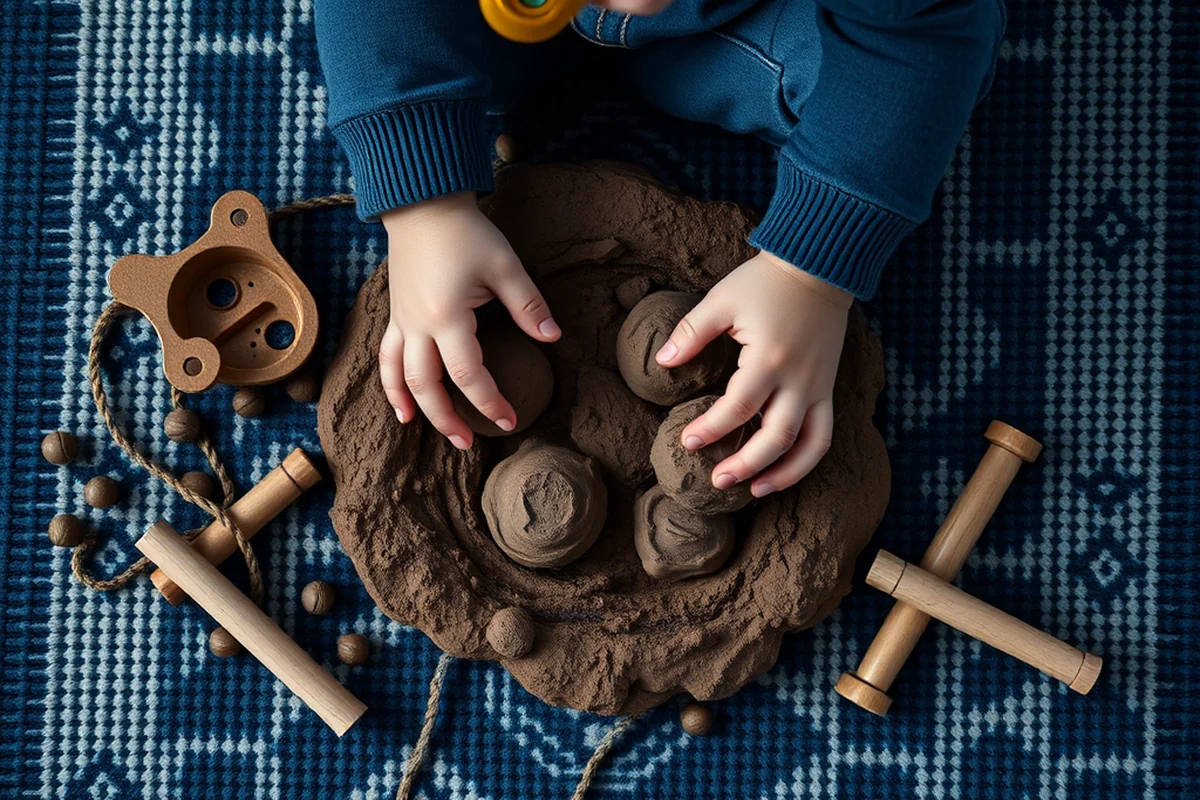
I’ve found that the best way to support creativity in a mud kitchen is to avoid over-directing. Instead of telling my daughter what to make, I let her decide. One day she made a 'cake' out of mud and leaves, another day she built a 'bridge' from sticks. Each time, she was fully engaged, and I saw her problem-solving skills improve.
I’ve also noticed that when I introduce new materials — like leaves or stones — she becomes more imaginative. The first time I brought out some pebbles, she used them as 'jewels' in a mud 'cake.' It was unexpected, but it was also a great way to spark her creativity.
I believe that the key to encouraging creativity is to remain present and supportive. I stay nearby, offering help when needed, but I let her lead the way. This kind of play builds confidence and independence in a way that structured activities often don’t.
How to Keep a Mud Kitchen Clean and Organized
I learned the hard way that if you don’t set boundaries, the mess can get out of control. I once let my daughter dig into the dirt without a plan, and within minutes, the entire backyard was covered in mud. That taught me the importance of having a specific area designated for the mud kitchen.
I now use a tarp to collect the dirt and a few buckets for mixing. I also have a small hose to help clean up. My daughter knows that after playtime, we all help clean up — and she’s proud of the work we do together.
I’ve found that a little structure makes a big difference. By having a set area and a few simple tools, I’ve been able to keep the mess manageable while still allowing my daughter the freedom to explore and play.
How Often to Use a Mud Kitchen and Outdoor Art Activities
I’ve found that using a mud kitchen a couple of times a week keeps my daughter engaged and excited. We usually set it up on the weekends, and it becomes a part of our routine. She looks forward to it, and it gives us a chance to disconnect from screens and reconnect with each other.
I’ve noticed that her mood and focus improve after these sessions. One day, she came in from the yard and said, 'I made a castle today — and it was the best day ever.' That kind of joy is powerful and worth making a regular part of our lives.
I believe consistency is key. Even just 30 minutes of play a few times a week can make a huge difference in a child’s development and happiness. It’s a small investment of time that yields big returns in creativity and well-being.[3]
Consistency is key — even a few minutes of play can make a big difference.
How to Involve the Whole Family in a Mud Kitchen
I’ve learned that when the whole family participates, the mud kitchen becomes a place of connection. I’ll sit with my daughter, helping her mix mud and water, or I’ll build a 'restaurant' with my son. It’s messy, but it’s also a lot of fun — and it brings us closer together.
I’ve noticed that when we all join in, my daughter is more engaged and more creative. She’ll ask me to help her shape a 'cake' or to build a 'bridge.' It’s a chance for us to bond and to explore together. It’s something I never take for granted.
I believe that involving the whole family in a mud kitchen is one of the best ways to create lasting memories. It’s messy, it’s loud, and it’s full of laughter — but it’s also a chance to be present with the people I love the most.
🌱 Gentle Approach
Focus on slow, mindful exploration with minimal mess and a calm, structured environment.
⚡ Fast-Track Setup
Use quick, easy materials like buckets, tarp, and water to create a mud kitchen in minutes.
🌍 Travel/Outdoor Setup
Set up a portable mud kitchen using lightweight items for trips or camping adventures.
👨👩👧👦 Multiple Kids Setup
Design a mud kitchen that accommodates multiple children with shared tools and open-ended play areas.
🔄 Regression Reset
Use a mud kitchen as a tool to help children process emotions or reset after a difficult day.
| The mistake | Why it happens | The fix |
|---|---|---|
| Trying to control every aspect of the play. | Overdirecting can stifle creativity and make the experience less enjoyable for the child. | Let your child lead the way — be present but avoid micromanaging their play. |
| Not involving the whole family in the cleanup. | If only one person cleans up, it can create resentment and make the activity feel like a chore instead of a joy. | Make cleanup a family activity — it builds teamwork and makes the process more fun. |
| Using too many tools and materials at once. | Too many options can overwhelm a child and make the experience less focused and engaging. | Start with just a few materials — like buckets, water, and sticks — and expand as your child becomes more comfortable. |
Mud Kitchen & Outdoor Art
Common Questions
What age is best for a mud kitchen?
How do I keep my child from getting too messy?
What if my child is hesitant to get dirty?
How long should a mud kitchen session last?
Cite this guide
Messysenses (2026). Mud Kitchen & Outdoor Art. https://messysenses.com/mud-kitchen-outdoor-art/
Feel free to cite or share this guide.
References
- How mud boosts your immune system - BBC (colorado.edu)
- Pea Pods for Preschoolers Day: Garden Party! (Ages 3-5 with an ... (arb.umn.edu)
- Outdoor Learning - Associated Students - San Diego State University (childcare.sdsu.edu)
- Outdoor Explorations - Children's School - (cmu.edu)